
Seamus Cullen’s Personal Web Site
Featuring Local History from North Kildare
The Origin of Coill Dubh
The Fastest Growing Town in Ireland
Published in the Liffey Champion, 11th of November 2023
Coill Dubh, in west Kildare, a settlement that has only been in existence for 70 years was identified in the 2022 census as the fastest-growing town in the state. It has a population of slightly under 1,500, which is actually a 98 percent increase in the six-year period from 2016.
This is not the first time that towns in County Kildare have been recorded as the fastest growing settlements in the country: Newbridge, Leixlip, and Celbridge have all held that distinction since 1966, when the population began to increase for the first time since the 1847 famine.
Coill Dubh stands out as having an important uniqueness as a village. It was a purposely built settlement, unlike other urban centres which emerged in a gradual process throughout history. Built in 1952, it was the only settlement constructed in Kildare during the 20th century by an independent Irish Government. Furthermore, all the modern necessities of the time were provided, including electricity and running water. The sheer scale and size of the settlement was unusual for that period, with 160 family homes built in a greenfield area two miles from Robertstown, the nearest village.
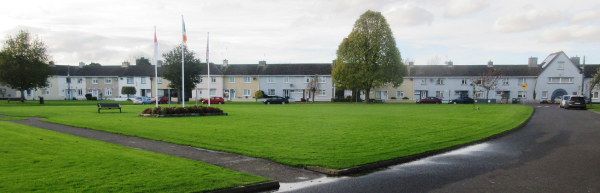
Coill Dubh, 2023.
The need to build a village such as Coill Dubh in the 1950s was due to circumstances relating to an energy crisis a decade earlier during the Emergency. Throughout the Second World War (1939 to 1945), coal imports from Britain largely ceased, and as a result, the Irish Government turned to peat production to provide heating and energy.
The nearest area of extensive bog land to Dublin, the Timahoe section of the Bog of Allen, was of vital importance for providing fuel to homes, factories, and institutions in the capital. Before the era of mechanisation, turf was cut and saved by manual labour. Men from all over the country came to work for Bord na Móna, and they were accommodated in hostels throughout the midlands. Wages in some cases were as low as £2 per week, but for many, this was a better alternative than emigrating to work in the factories of war-torn Britain.
There were five hostels built to accommodate workers in the general Timahoe area. The first three, known as Timahoe North, Timahoe Middle, and Timahoe South, were situated respectively in the townlands of Mucklon, Corduff, and Cooleragh. Two other hostels were located in Allenwood and Drummond. In addition, Robertstown Hotel was used at one stage to house workers. In all, up to 1,000 men were accommodated in the hostels during the peak years.
Not surprisingly, the Timahoe area during this period was a hive of activity. Instead of coal being loaded at the docks in Dublin for domestic use, trucks and barges were busy travelling to the capital from Timahoe transporting turf.
The largest area of employment in County Kildare today is Leixlip, where Intel operates one of the biggest factories in the country. But in 1940, Timahoe was the hub of one of the nation’s largest employment centres where the employer was the Turf Development Bord, which was later reconstituted as Bord na Móna in 1942.
While the Second World War ended in 1945, and normality returned to some extent, the turf-producing industry continued to flourish, with the government accelerating the development of bogs for power generation and briquette manufacture. Peat power stations were commissioned to generate electricity, and the construction of Allenwood peat-fired power station began in February 1949. Some hostels were extended, with figures from 1948 indicating that Bord na Móna employees throughout the country had increased to 3,218.
Clearly, at this stage there was going to be a need for a permanent workforce, particularly in the Timahoe area. Furthermore, by the late 1940s, six or seven years after the establishment of the first hostels, the men were settling down and getting married. The hostels were obviously not suitable for married men with families. In order to retain the workforce, more substantial, permanent accommodation was necessary. Consequently, a decision was made by Bord na Móna to provide new housing schemes in appropriate locations to support the turf development programme and ensure its continuity.
A Dáil Éireann Act of 1950 provided the authorisation for these houses, and within two years, Board na Móna’s housing scheme was well under way.
The leading town planner in the country, Frank Gibney, was given the job of planning the various housing schemes. In all seven schemes were undertaken. The schemes can be divided into two categories. The first category consisted of schemes adjacent to well-established settlements: those at Kilcormac (105 houses), Rochfortbridge (98 houses), Bracknagh (50 houses), and Lanesboro (61 houses). There were three schemes in the second category, which were located in rural areas outside the perimeter of established towns or villages. Two were in the vicinity of Lanesboro: Cloontuskert, (69 dwellings) and Derryhaun, (23 roadside cottages).
The third and biggest settlement in this category, and in the entire Bord na Móna housing project, was planned for Timahoe. This scheme was intended to accommodate by far the largest hostel-based workforce. Although a second scheme in the Timahoe area was originally planned near the Timahoe North Hostel, it was shelved and one single Bord na Móna village was undertaken in the area.
A suitable site for the new village, close to both the Timahoe South Hostel and the Allenwood power station, was acquired in the townland of Blackwood. The new village took its name from the Irish for Blackwood: Coill Dubh. It was the most substantial, remote and ambitious of all the schemes.
Frank Gibney the architect drafted a largely organic design for the village. It was indeed a complete village in itself, with provision for a school and church. Of the 160 houses, 130 were two-story and 30 bungalows. In addition, four shops were included in the complex.
The village entrance featured an open space where houses faced the main road across a front green. Proceeding past this area to the left led to a small group of houses with a rectangle open space, and then into a large central green, partially rectangular in shape, which opened south-westward into an almost circular group of bungalow houses surrounding a small green. To the east a second access road led to the central green.
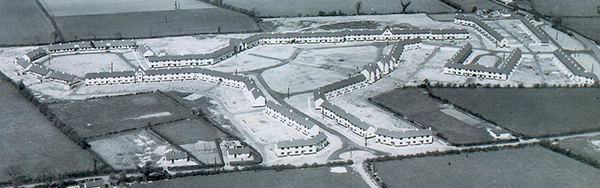
Aerial photo of the completed village of Coill Dubh, 1952.
Courtesy Bord na Móna Living History.
McInerny’s of Scariff obtained the contract of building the houses, which comprise three bedrooms, a living room/kitchen complete with a turf range, a scullery, and a fuel store. The average permitted budget for each house was £800. The architect meticulously worked within this limitation, providing houses that have withstood the test of time, due mainly to good construction and their attractive appearance.
Although bathrooms were included it became necessary to exclude baths in order to comply with the allocated budget. However, they were later installed with an increase to tenants of 6d. per week onto the 7/6d weekly rent.
The architectural design was raised to a degree exceeding the ordinary standard of local authority housing of that time, due to Gibney’s insistence upon the provision of feature buildings and particular design touches. As in all of his schemes, there are no enclosed front gardens with the footpaths quite close to the front of the houses. However, there are extensive rear gardens. This gave the schemes a largely international urban appearance. It was the first occasion of a new scheme in rural Kildare that the houses were provided with electricity and a hot and cold water supply. Additionally, the roads in the village featured tarmacadam surfaces, and the grass margins were neatly planted with flowering shrubs.
The first 17 tenants occupied their homes in Christmas week, 19 December 1952. By the 30th of March 1953, 60 of the houses had been allocated, and the remaining 100 were occupied by the following October.
Houses built in County Kildare just prior to the Coill Dubh scheme included the Donore Cottages close to Caragh, which were constructed by Kildare County Council between 1948 and 1950. While Donore is an excellent scheme, it lacked the extensive green space and amenities found in the Bord na Móna houses.
The official opening of Coill Dubh was held on the 30th of March 1953, when Dr Keogh Bishop of Kildare and Leighlin, blessed the new village in the presence of leading Bord na Móna officials, including the chairman, Robert Barton, and Todd Andrews, the managing director.
Later, at a luncheon in the nearby Timahoe Hostel, Bishop Keogh said that the scheme was an example of how the country could be developed and the countryside populated. Todd Andrews, who indicated that the village would be known by its Irish name, pointed out that with these houses, Bord na Móna had provided workers with an opportunity to live in reasonable comfort and had given them a new way of life. Others speaking at the event included the local parish priest, Fr. John Doyle, and Frank Gibney.
To complete the development of the village, a number of projects needed to be undertaken, including the construction of a church, a school and a community hall. The school was the first to be built and opened in October 1956. Although a site for a church was provided in the original plans of the new village, rural parishioners opposed the location. They preferred the church to be sited closer to Timahoe village, two miles to the north. A compromise saw the new church built at Cooleragh, almost one mile north of Coill Dubh. Dedicated to Christ the King, the new church was opened in October 1963, replacing a temporary chapel located in the nearby Timahoe Middle Hostel.
Other developments providing necessary services included a new District Dispensary in 1961, a Credit Union branch in 1971, and a new Community Centre in 1974.
Finally, in 1989, Bord na Móna handed control of the village over to local residents. While the Bord had previously managed village maintenance, this responsibility passed to the residents, who subsequently preserved their pristine surroundings.
Today, new housing estates are springing up both in Coill Dubh and nearby Cooleragh. Therefore, it is not surprising that Coill Dubh significantly exceeds the traditional 1,500 population criterion for town status. One amenity, however, that still alludes Coill Dubh is a public house and today it holds the distinction of being the only town in Ireland without a pub.
Sources
- Irish Independent, 31 March 1953
- Irish Press, 31 March 1953
- Nationalist & Leinster Times, 22 April 1961, Fergal McCabe, ‘Urban and Rurality’
- Coill Dubh Book Committee, Coill Dubh 1952–1992, (Naas, 1992)
- Maureen Gill-Cummins, ‘They kept the home fires burning: The story of Peat Production on the Kildare-Offaly Bogs in the 1940s and 50s’ in Journal Kildare Archaeological Society, Vol XIV (part II) (2002–3), p. 208
- John Larkin and Owen Denneny, ‘Coill Dubh new school is blessed, 1956’ in A Path through the Bog, (Naas, 2011), pp 31–33.
- Andy Flaherty, Building of Cooleragh Church, in The Bridge 2017, p. 31–32
- www.oireachtas.ie/en/debates/debate/dail/1950-05-03/19/
- www.bordnamonalivinghistory.ie/article-detail/urbanity-and-rurality-the-bord-na-mona-villages-of-frank-gibney/